.exerlife-kb{
font-family:Arial, Helvetica, sans-serif;
max-width:1100px;
margin:auto;
line-height:1.75;
color:#17202a;
}
.exerlife-kb h2{
margin-top:45px;
border-left:6px solid #0f4c81;
padding-left:14px;
font-size:28px;
}
.exerlife-kb h3{
margin-top:30px;
color:#0f4c81;
}
.exerlife-kb p{
margin-bottom:16px;
font-size:16px;
}
.exerlife-kb table{
width:100%;
border-collapse:collapse;
margin:25px 0;
font-size:15px;
}
.exerlife-kb th{
background:#0f4c81;
color:white;
padding:12px;
border:1px solid #ddd;
}
.exerlife-kb td{
padding:12px;
border:1px solid #ddd;
}
.exerlife-kb tr:nth-child(even){
background:#f7f9fb;
}
.kb-box{
background:#eef5fb;
padding:18px;
border-left:5px solid #0f4c81;
margin:25px 0;
}
.kb-warning{
background:#fff3f3;
padding:18px;
border-left:5px solid #c0392b;
margin:25px 0;
}
.kb-highlight{
background:#f6f9fc;
padding:18px;
border:1px solid #d9e1ea;
margin:20px 0;
}
Abstract
Kettlebell training is one of the most versatile resistance training systems in modern fitness. A single kettlebell can develop strength, power, endurance, balance, coordination, and mobility. This article serves as a structured reference guide for kettlebell training used by personal trainers and strength professionals. It explains the origin of kettlebells, how to start training safely, how to select weight based on goals and population, and how to structure training programs based on anatomical movement systems.
—
1. What Is a Kettlebell?
A kettlebell is a cast iron or steel weight shaped like a cannonball with a handle attached to the top. Unlike dumbbells, kettlebells have an offset center of mass. This unique design creates additional stability demands during movement, making kettlebells highly effective for functional strength training.
| Feature | Description | Training Benefit |
|---|---|---|
| Offset center of mass | Weight sits below the handle | Improves stabilization and coordination |
| Single handle | Allows one or two hand grip | Supports unilateral and bilateral exercises |
| Compact design | Small equipment footprint | Ideal for home training |
| Ballistic movement capability | Supports dynamic exercises | Develops power and conditioning |
—
2. History and Origin of Kettlebell Training
Kettlebells originated in Russia during the 18th century. Initially used as counterweights in agricultural markets, they were eventually adopted for strength training by laborers, soldiers, and athletes.
By the 19th century, kettlebell lifting had become part of Russian physical culture. The competitive sport known as Girevoy Sport later emerged, featuring endurance-based kettlebell lifting competitions. In the early 2000s, kettlebell training gained international popularity as strength coaches recognized its effectiveness for functional training.
—
3. Why Kettlebells Are Becoming More Popular
| Reason | Explanation |
|---|---|
| Functional strength | Kettlebell exercises mimic real-life movements. |
| Efficiency | Strength and cardio can be trained simultaneously. |
| Minimal equipment | One kettlebell can provide a full workout. |
| Versatility | Hundreds of exercises are possible. |
| Longevity fitness | Improves balance, mobility, and muscular strength. |
—
4. How to Start Kettlebell Training
Choosing the Correct Weight
| Population | Beginner | Intermediate | Advanced |
|---|---|---|---|
| Women | 6–8 kg | 10–14 kg | 16+ kg |
| Men | 10–12 kg | 16–20 kg | 24+ kg |
| Seniors | 4–6 kg | 6–10 kg | 12+ kg |
—
Training Variables
| Variable | Recommendation |
|---|---|
| Repetitions | 6–15 repetitions |
| Sets | 3–5 sets |
| Rest | 45–90 seconds |
| Training frequency | 2–4 sessions per week |
| Progression | Increase weight gradually |
—
5. The Four Body Systems in Kettlebell Training
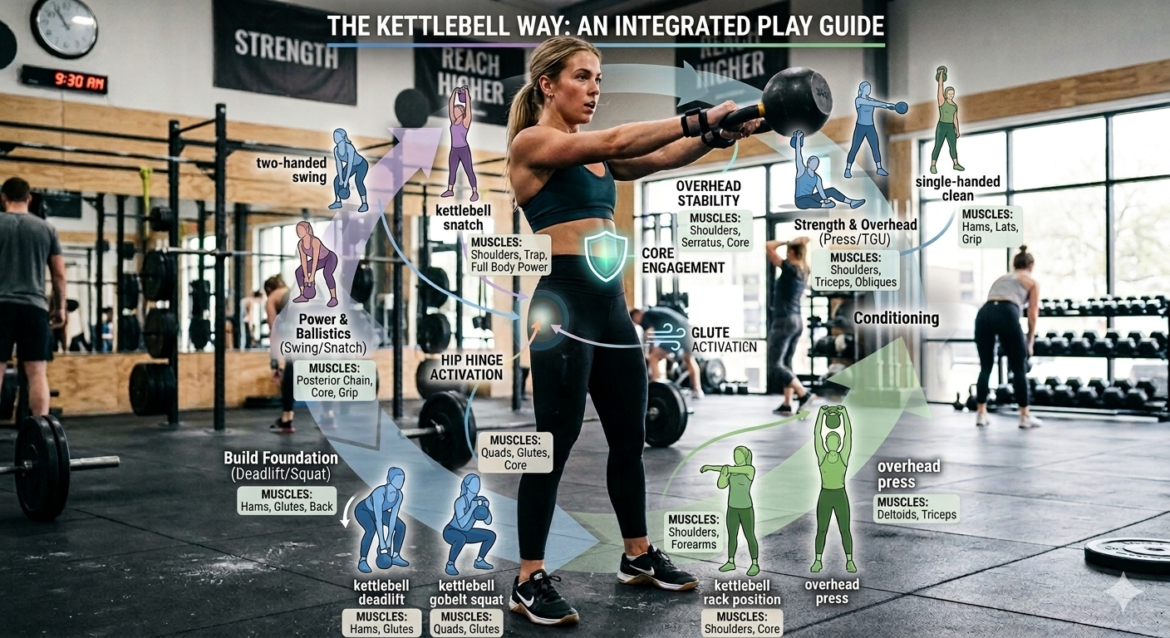
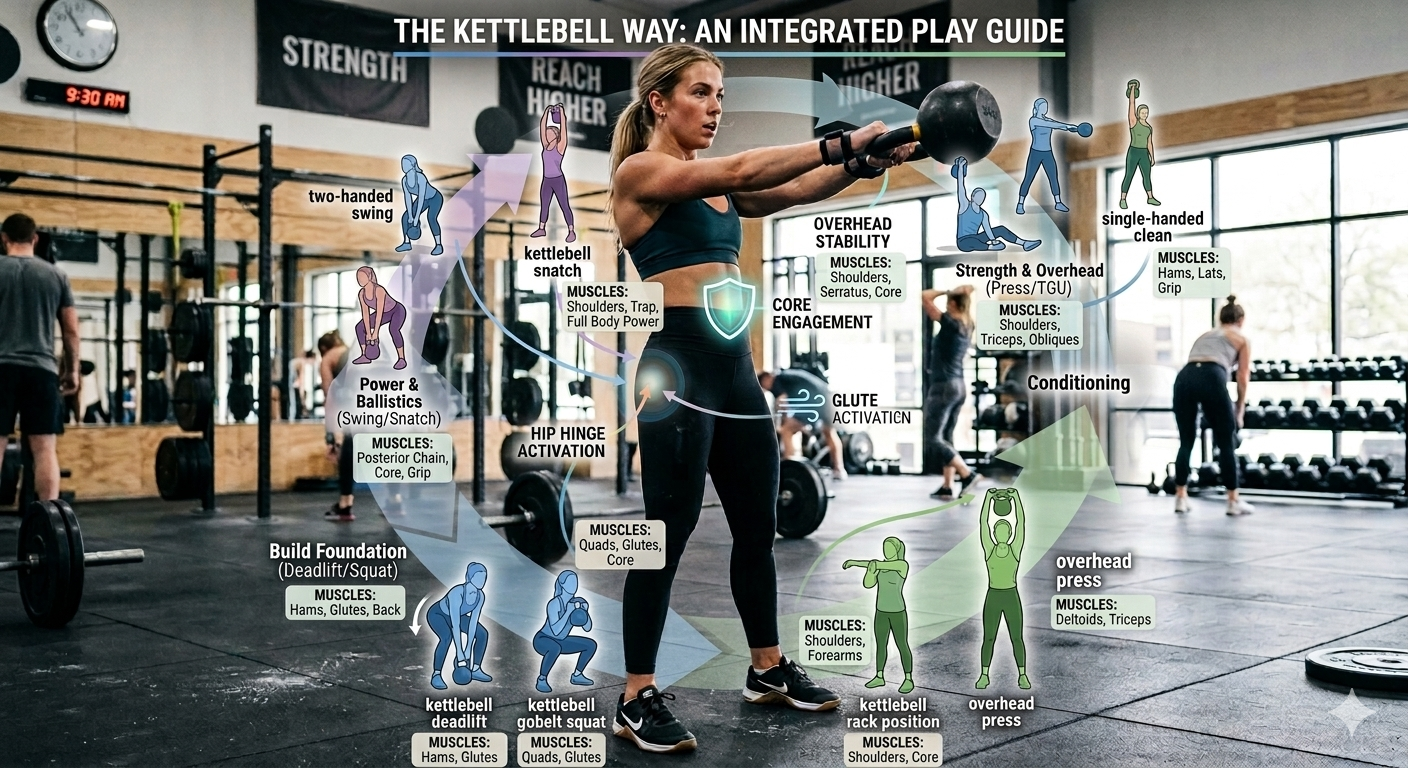
Kettlebell exercises can be organized into four anatomical systems to simplify program design.
| System | Main Muscles | Example Exercises | Training Purpose |
|---|---|---|---|
| The Engine | Glutes, hamstrings | Deadlift, Swing, Snatch | Power and posterior chain strength |
| The Pillar | Core stabilizers | Suitcase Carry, Windmill | Stability and anti-rotation strength |
| The Frame | Shoulders, chest, back | Press, Row | Upper body strength |
| The Base | Quadriceps, hips | Goblet Squat, Lunge | Lower body support and balance |
—
6. Common Kettlebell Exercises
| Exercise | Target Muscles | Difficulty |
|---|---|---|
| Kettlebell Deadlift | Glutes, hamstrings | Beginner |
| Kettlebell Swing | Posterior chain | Beginner |
| Goblet Squat | Quadriceps, glutes | Beginner |
| Kettlebell Press | Shoulders | Intermediate |
| Kettlebell Row | Back muscles | Intermediate |
| Kettlebell Snatch | Full body | Advanced |
—
7. Most Common Kettlebell Training Modes
| Training Mode | Main Goal | Typical Exercises |
|---|---|---|
| Technique training | Movement skill development | Deadlift, Clean |
| Strength training | Increase muscular force | Squat, Press |
| Power training | Explosive strength | Swings, Snatches |
| Conditioning | Cardiovascular endurance | Swings, circuits |
| Complex training | Full body integration | Clean → Squat → Press |
| Longevity training | Joint health and mobility | Deadlift, Carry |
—
8. Common Mistakes in Kettlebell Training
Using arms instead of hips during swings
The swing should be powered by hip extension rather than arm lifting.
Rounded spine
Poor spinal posture increases risk of lower back injury.
Incorrect rack position
Improper positioning may cause wrist or forearm discomfort.
—
9. Internal Reading on ExerLife
- The Science of Strength
- Unlocking Flexibility: Mobility Guide
- Balance Training Guide
- Crafting the Perfect Recovery Routine
- Cardio Workout Guide
—
Conclusion
Kettlebell training represents one of the most efficient and adaptable strength training systems available. Its simple design allows for dynamic movement patterns that simultaneously develop strength, endurance, balance, and coordination.
When used with proper technique and structured programming, kettlebells can serve as a lifelong training tool supporting athletic performance, injury prevention, and healthy aging.
—
Academic References
- Lake JP & Lauder MA. (2012). Kettlebell swing training improves maximal strength.
- Jay K et al. (2011). Kettlebell training for musculoskeletal health.
- Manocchia P et al. (2013). Transference of kettlebell training to strength, power and endurance.
- American Council on Exercise. Kettlebell Training Study.
- McGill SM. Low Back Disorders.
